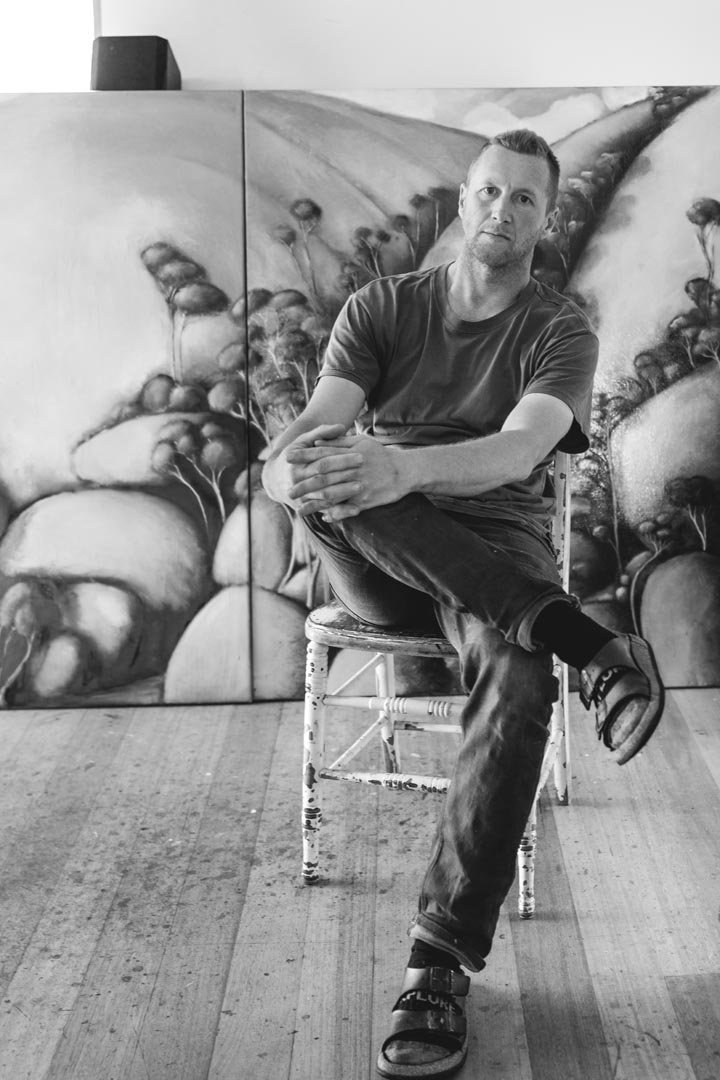
About Cameron Brooke
Painting becomes a form of transmission — not of what was seen, but of what was felt.
I have always been drawn to places that resist a single reading. As a child, I could become absorbed by a few inches of earth or grass, imagining within it the contours of a much larger world. That way of seeing has never really left me. In the landscape, scale is constantly slipping: the pattern of lichen can resemble a continent seen from above; a distant range can become a crease, a scar, a surface. The intimate and the immense begin to mirror one another. I am interested in that instability — in the moment sustained attention causes a landscape to exceed ordinary description.
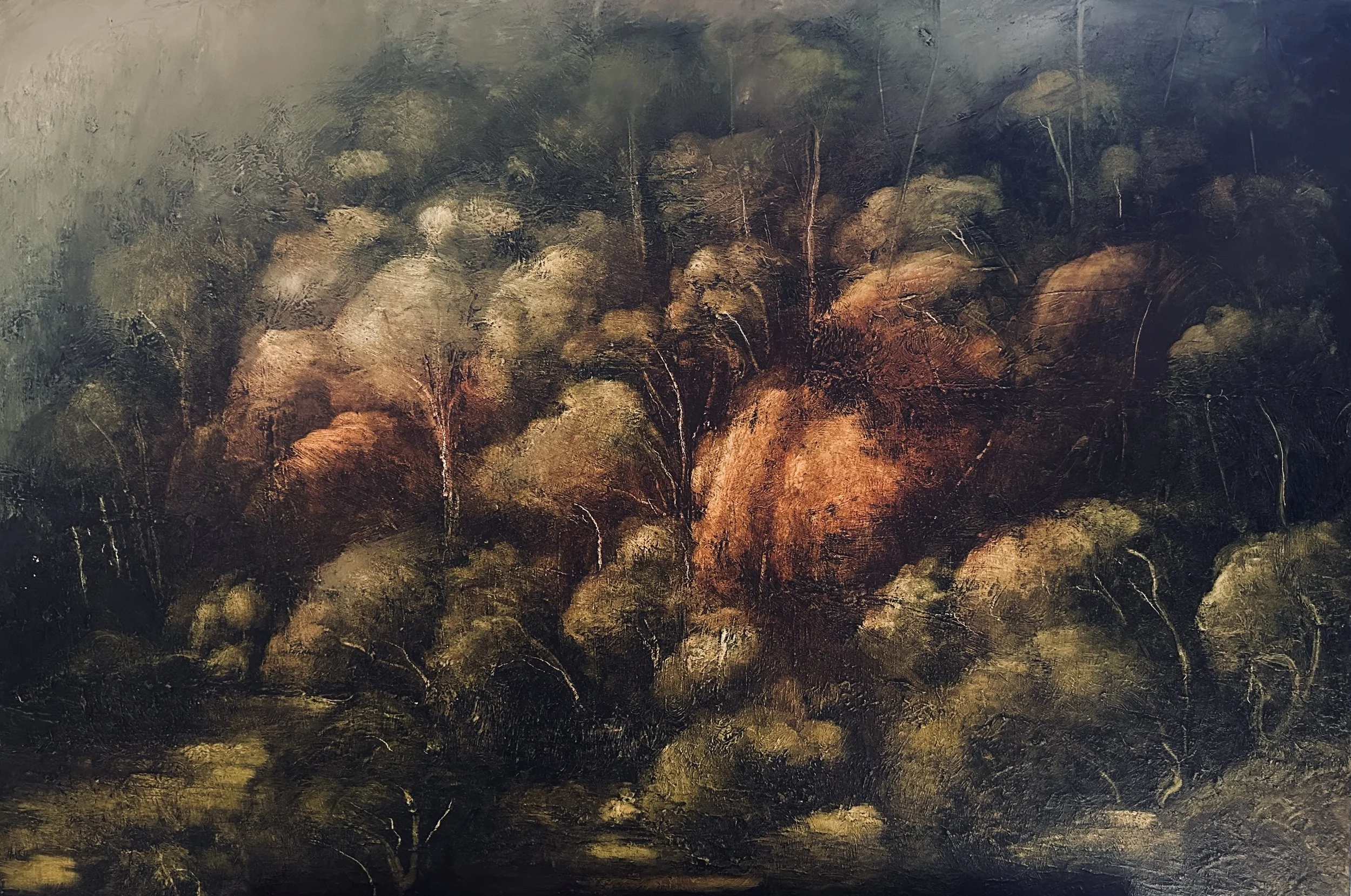
The paintings emerge in much the same way. Many begin on canvases that already carry the remains of earlier work. Paint is laid down heavily, then dragged, rubbed and worn back. Shapes disappear and others surface. Colour buried months or years earlier can suddenly re-enter the painting. At times the process feels archaeological, as though I am excavating rather than constructing the image. Horizons become uncertain. A painting might suggest forest, aerial terrain, stone, water or something bodily without settling completely into any of them.
I work without a blueprint. Oil is squeezed directly from the tube and moved with hands, rags and large brushes. I try to remain responsive to what the painting reveals rather than deciding too early what it should become. This is where instinct matters. The work moves between control and surrender, recognition and uncertainty, until something begins to hold.
I don't want to pin landscape down. I want the paintings to retain some of its unknowability — the sense that beneath what we recognise there is always something else occurring. Perhaps that is why, under sustained attention, the landscape can sometimes seem to look back.
I don't know if landscapes remember us. I do know they change the way we remember ourselves.
The surface of the canvas becomes a site of encounter.
I know a painting has found its footing when something unexpected emerges — when a form or force announces itself, like a telescope locking onto a distant star. At that moment the pace shifts. What has appeared must be held carefully, respected, and allowed to breathe. The act of painting becomes one of tending rather than forcing. After years of working this way, a deep trust has formed. The work will reveal itself — if I get out of the way. Like meditation, it is a discipline of surrender. This is not a style, but a way of being with the land: stepping back, listening closely, and allowing place to lead.
This is not a style,
but a way of being with the land.
I paint without audience or agenda. The works are acts of reverence rather than representation — quiet invitations to listen, to feel, and to remember the old conversation between land and body. These paintings are not about landscape. They are about being with it. Being claimed by it. Letting it speak. I am based in southern Tasmania and also paint and exhibit in East Arnhem Land, where I continue to deepen my relationship with Country and its many voices.
— Cameron Brooke